The verb that does nothing
The short version
Be links a subject to a description. In the present, its three forms are am, is and are. The subject decides which one you need.
What follows be is usually a description rather than an action.
The clock on the tower at the end of Bell Street stopped years ago. The council has finally asked Mina to look at it. She stands underneath with a notebook.
The tower is cold. The glass is cracked. The hands are bent. I am hopeful.
Read those four sentences and try to spot somebody doing something. Nothing gets fixed, lifted, wound or carried. You just take a thing and stick a description onto it. The little word holding the two together is be. Think of it as the glue between the tower and cold.
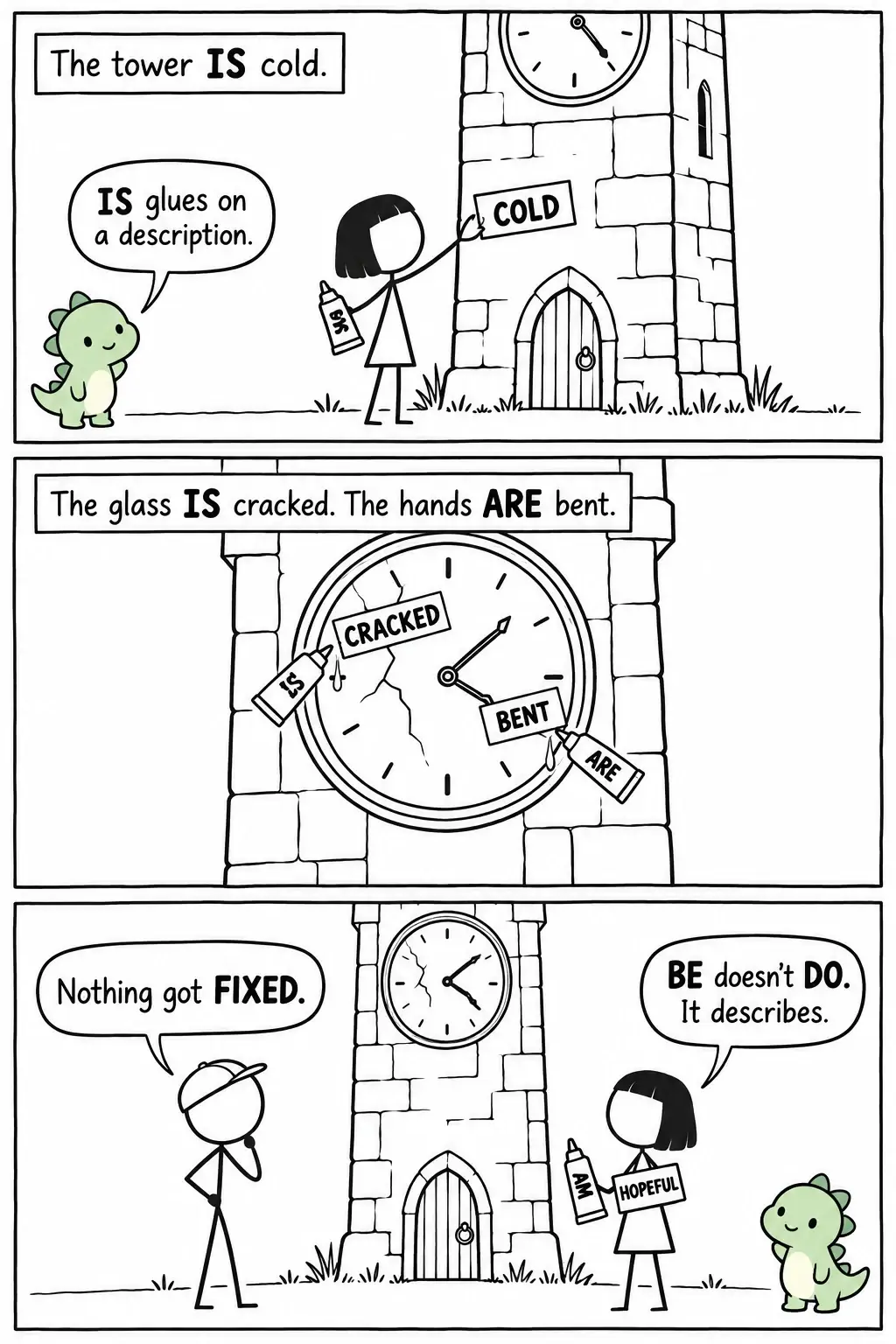
It is the least busy verb in English and the hardest-working. It is also the only one with three shapes in the present:
I am
He, she, it, and any single thing take is.
You, we, they, and any plural subject take are.
Every other verb in the language gets by with two shapes at most. Be has kept three. It is the oldest word in the room, and nobody has ever managed to tidy it up.
Look at what Mina puts after it: cold, cracked, bent, hopeful. Those words give you descriptions. That is usually what you find here, rather than an action. The verb links the thing you are talking about to what you want to say about it.
So you are not hearing what the subject did. You are getting a description attached to it. In this clock's case, the same description has been hanging there for a very long time.
In the practice questions below, find the subject, count what it names and choose am, is or are.
The clock on Bell Street is two hundred years old.
One clock, and it is very old.
The hands are bent out of shape.
Both hands are damaged.
I am here about the tower clock.
The speaker has come about the clock.
Theo is sure the motor can be saved.
Theo believes the motor is repairable.
Look left, then count
The short version
The subject chooses the form of be: I am, one other person or thing is, and plural subjects are.
You and they take are even when they refer to one person.
On Tuesday, Mina climbs up with Lena. The room behind the clock face is smaller than either of them expected. There is plenty to describe.
I am covered in dust. You are taller than me. We are both too big for this room.
You get three forms because you have three subjects. Imagine each subject handing the verb its instructions. The description does not get a vote. Neither does the length of the sentence, or how far the verb sits from the front.
Here is who asks for what:
I takes am. Nothing else ever does.
One thing or one person takes is. The pendulum is heavy. Theo is downstairs.
More than one takes are. The gears are rusty. Lena and I are stuck.
You takes are, whether you mean one person or a whole room full of them.
That last one can trip you up. You are looking at one person, but the verb still says are. English gave up its separate singular you a few hundred years ago, and the verb never moved back. Singular they works the same way: they are, whether you mean one person or several.
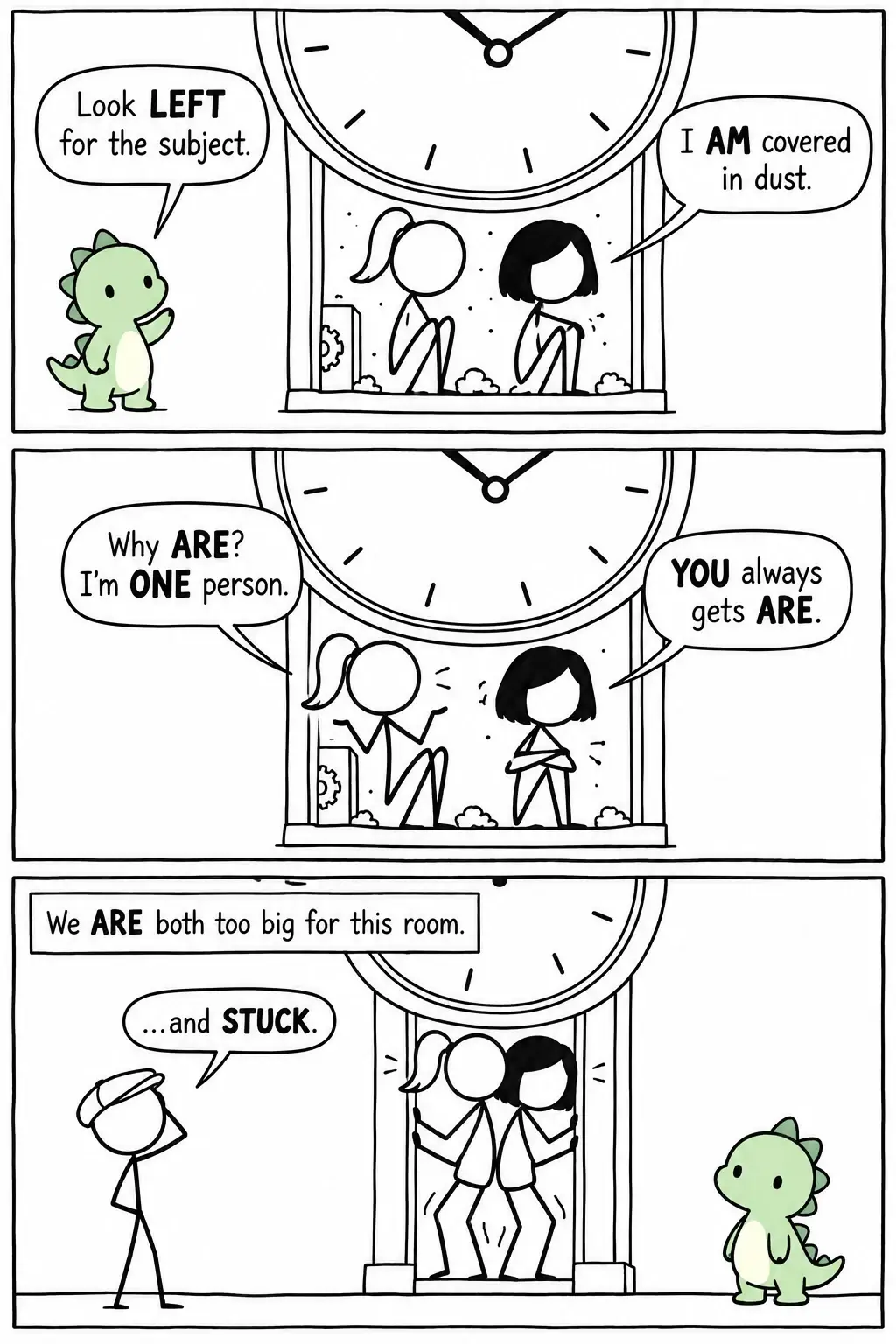
You could keep staring at the table. A more useful habit is to look left. Find the person or thing the sentence is actually about. Words can sit between that subject and the verb, but they do not take over the job of choosing.
Then ask which group you have: I, one other person or thing, or the rest. That is all the dusty room requires. Getting out of it is another matter.
In the practice questions below, find the subject first and choose the form of be that goes with it.
The gears behind the clock face are rusty.
Several gears have rusted.
You are taller than me.
The other person is the taller one.
Lena and I are both covered in dust.
Two people are dusty.
The pendulum is heavier than it looks.
One pendulum, and it is heavy.
The word that goes missing
The short version
An English sentence needs a verb. When you put a description after the subject, be fills that slot, including before not.
If you cannot find a verb, the missing word is almost always a form of be.
On Wednesday, Theo comes to look at the wiring. He writes a note and leaves it on the bench:
The coil fine. The contacts dirty. I not sure about the motor.
You know what he means. Everyone does. But each sentence has a hole where its verb should be. The missing word is small enough to overlook and important enough to hold up the whole sentence:
The coil is fine. The contacts are dirty. I am not sure.
Think of the verb as a support under a bench. You can still see what the bench is for when the support is missing. You would want to put it back before relying on it.
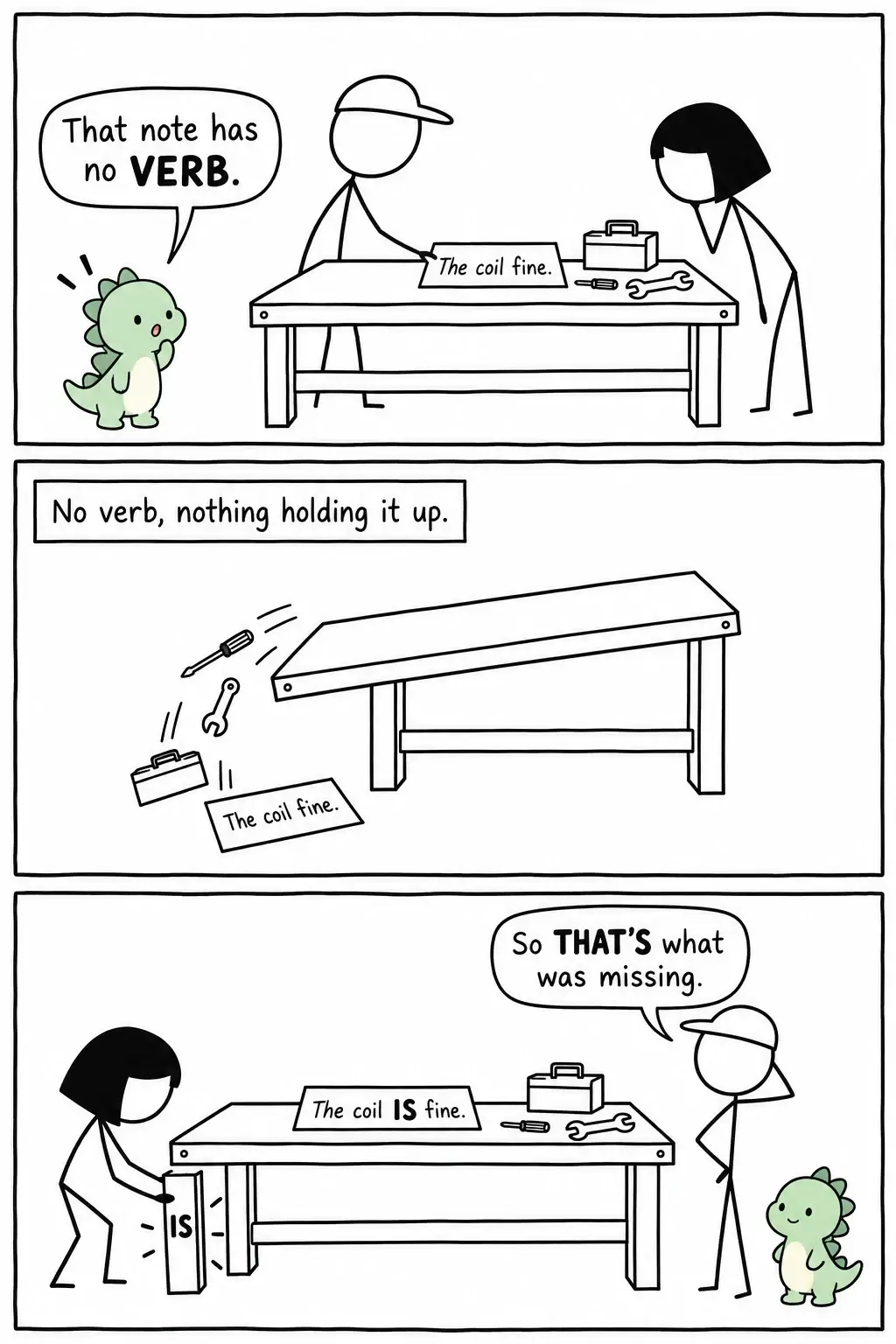
This deserves a little time because, in a great many languages, that slot really is empty. You put the thing next to its description and you have a finished sentence. Add a separate word for being and it sounds like a hiccup.
English will not do that. It wants a verb somewhere in the sentence. When you are giving a description rather than an action, be fills the gap.
There are two places where it most often gets left behind. One is before a description. With no action to remind you, it is easy to write this:
✗ The tower cold.
✓ The tower is cold.
The other is before not. The negative can feel as though it has done enough work on its own:
✗ I not sure.
✓ I am not sure.
Read the sentence and point to its verb. If you cannot find one, the missing word is almost always a form of be. Theo's note needs those little supports put back.
In the practice questions below, fill each gap with the form of be that completes the sentence.
The coil is fine.
The coil has no fault.
The contacts are dirty.
The contacts need cleaning.
I am not sure about the motor.
The speaker has doubts about the motor.
The tower stairs are steeper than they look.
The stairs are steep.